Monday, November 8, 2010

Differences in nutshells - video editing and software upgrades

Avidemux has proven a simple yet efficient piece of software for video editing in Linux. Most of my videos on Vimeo has been produced using nothing else. On the Macbook however, iMovie steals the attention with its intuitive interface, drag-and-drop handling of multiple clips and near magical completion of complex operations.

But working with a combination of the two has proved quite practical. Each has its weaknesses.

Video editing

Making a video of several excerpts of other videos is much more convenient in iMovie. But as the videos in question have been downloaded from YouTube (mostly being in *.flv format) iMovie can't import them directly.

No problem since Avidemux opens anything and lists 16 different video codecs,  8 different audio codecs and 13 different containers for export options. That's a theoretical 1664 different combinations each with many possible varieties (quality settings and filters). And most combinations actually works - but check your output files because some might have failed without warning!
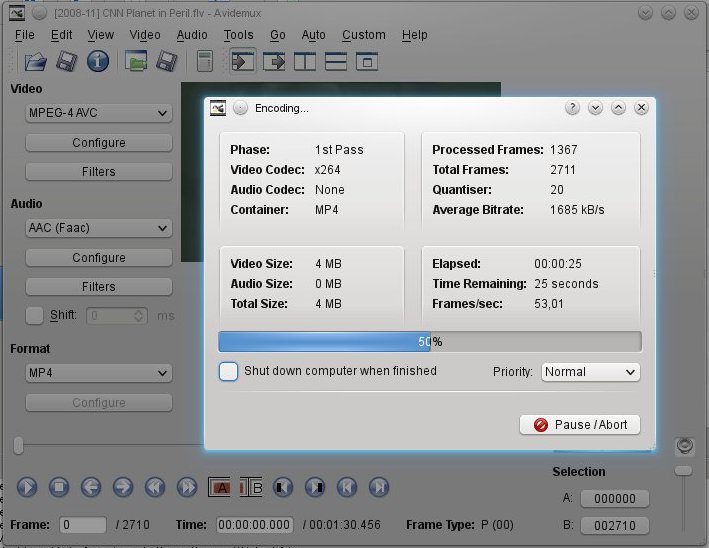

Powerful: Using Avidemux to save a .flv file downloaded from YouTube as something iMovie can import. Here by choosing MPEG-4 AVC as video codec (shown as "x264 in the encoding progress window), AAC (Faac) as audio codec and MP4 as container.

Saving a file in iMovie is a completely different experience. In fact it probably couldn't be any more different. And in this case I believe a screenshot will say more than a thousand words:

Fool proof: The export menu has a table listing resolutions on the vertical and target platforms on the horizontal making it hard to make a bad choice for video size. The file will be a special Apple type of MP4 and so far I haven't noticed anywhere in iMovie to change that.


iMovie, being ridiculously picky on the other hand, imports only about four (4) different video file types. Googling for some format that will work turns up a wide selection of software that will fix the problem without telling me how it does so - no doubt commercial trial versions most of them.

Software upgrades

So, mid-October with some excitement I notice my clear favorite photography manager is released in a new version 1.5. Mid-December the version available in openSUSE is still 1.2.

The digiKam website presents a new release of their awesome software.

Apple on the other hand misses few chances to throw a popup about iLife 11 at me. "iLife" - the suspiciously named package of audio, image and video editing software. When trying to get something done they want to tell me about the new features I can get for only about 55 euros. OK I peek at it: hmm... new backgrounds for title frames? Really?

Now, on a final notice, comparing Avidemux and iMovie really is comparing apples to oranges. Other programs for Linux should share the drag and drop multi clip functionality of iMovie. I wanted to try OpenMovieEditor since that program is what is mentioned in Crafting Digital Media by Daniel James which I bought. That program installed fine via YaST but didn't run so I posted a question in the openSUSE forum and got highly competent help pretty fast. Another user was able to help me find out which little extra package to install - now it runs but crashes at any edit.

Differences in nutshells indeed: Linux is free, very powerful and bleeding edge. The Mac is annoyingly commercial, fool proof and conservatively designed.


Friday, October 15, 2010

Number 1 sign your open source project is successful is...

...Microsoft produces an ad just to smear it. Behold the Microsoft anti-OpenOffice.org propaganda:


Finished laughing yet? OpenOffice.org can "affect grades" negatively!? What kind of sick and twisted teacher is saying that!? If anything, OpenOffice.org affected mine positively.

No, I will not list the approximately 9000 reasons I'm not using Microsoft Office unless when forced to. Obviously, OpenOffice.org was one of the first things I installed on my Mac when I got it.

If, and only if, you happen to be a multinational corporation then maybe Microsoft Office might be a good choice. (I do work for a multinational corporation using Microsoft Office there, thank you very much.) In all other cases what people actually mean when they postulate it is "better" is that it is what they are used to and that they are too lazy to get used to anything else.


Use OpenOffice.org


Just the fact that Microsoft have felt the need to commence smearing (something they have no doubt been doing for years against Apple) speaks volumes about how far OpenOffice.org has come. This consideration soothes my anger quite a lot.

Sunday, October 3, 2010

Apples and oranges

One blogger ditches Linux for Mac OS X. Another blogger corrects the first blogger on the uneven playingground in the comparison. This is  something I am painfully aware of, something that makes it harder to get writing here. But since this Stuart has written such a nice piece for now I'll just rip that off a bit...
[Linux and OS X are] quite different things – a complete solution purchased from Apple with an unsupported and free software install on Apple hardware [...] Mac users in my workplace are already impressed by my Plasma Desktop, but not by the big, grey, noisy Dell box that powers it, or the ugly Dell keyboard. With Apple, you get the whole package: nice hardware, nice software – working together. [...] Make some real Linux hardware, better quality and better presented than anything from Apple, with a Linux distro and Plasma Desktop tweaked to work perfectly with the hardware and sell it as the ultimate home computer. It would take money (big, established vendor money) and balls (no one ever got sacked for selling Windows, you might for this) but maybe, just maybe, you could be the next Apple. But free.
There is wisdom in the comments too:
If you choose a random computer, Linux is much more likely to work on it than Mac OS X. [...] Apple does not just sell a sleek computer with very user friendly software. Apple sells an image and a status symbol, a “lifestyle” if you will. [...] Whether an innovation spreads in society depends on a lot of factors and it being better is just one of many. So even if one sold the perfect “fully controlled” amazing looking computer with KDE and invested a lot of money in PR, it would by no means necessarily be commercially viable. [Zanoi]
 True enough, it appears that everything “just works” – but as with Windows this is true only if you do things the way Apple (Microsoft) decide you should work. [Kjetil Kilhavn]
OK. Now I'll go back to comparing apples and oranges: Just today I have been annoyed with the many links to Apple's iTunes store from inside iTunes, I gave up listening to some OGG-files, I gave up having it show album covers and I can only shake my head at the iPhoto application in comparison to Digikam. More complaining to follow, no doubt.

Also read Windows v Ubuntu at Linux in Exile if you can stomach another silly comparison. Hilariously concludes with "a narrow victory for Windows 7".